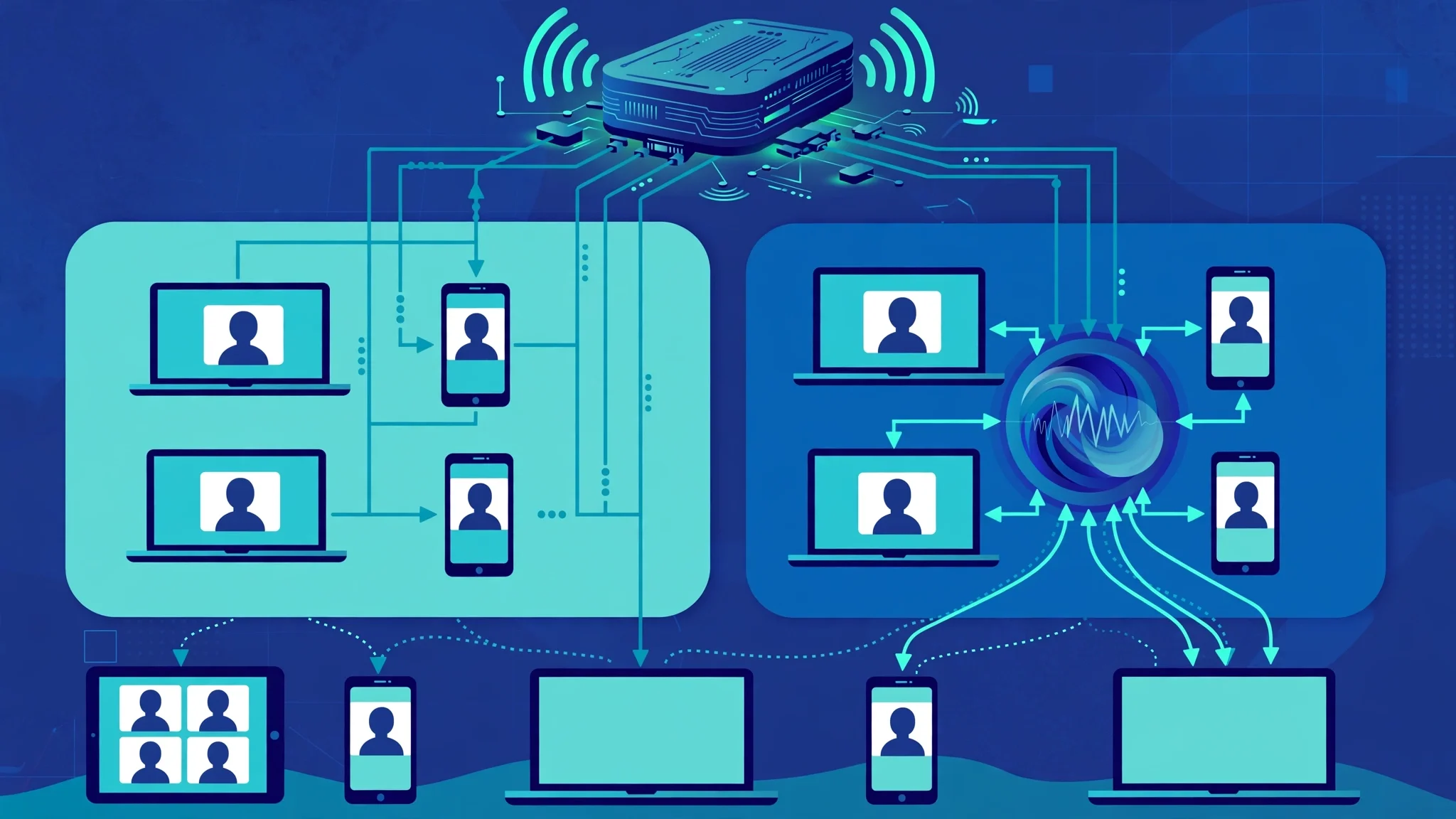
Smooth video conferencing isn’t just about cameras and internet connections. Behind every group call, virtual classroom, remote consultation, or corporate meeting lies an architectural decision that determines how much data gets sent, how heavily servers work, and what experience each participant receives. Two approaches commonly used in WebRTC-based systems are the Selective Forwarding Unit (SFU) and the Multipoint Control Unit (MCU).
Both help connect multiple participants, but they process media very differently. Understanding these differences from the start can prevent unnecessary infrastructure costs and quality issues when participant numbers grow.
WebRTC as the foundation for real-time communication
WebRTC provides APIs and protocols for exchanging audio, video, and data in real time through browsers and applications. However, WebRTC doesn’t mandate a single conference server design. Applications still need a signaling mechanism to exchange connection information, and often require STUN or TURN servers so devices on different networks can connect.
For two-person calls, a direct peer-to-peer connection may suffice. When participants multiply, each device must send and receive more media streams. This load drives the use of media servers like SFU or MCU.
What is an SFU?
An SFU receives audio or video streams from participants, then forwards selected streams to other participants without decoding and mixing all videos into a single composite image. In typical configurations, participants send one or more video quality layers to the SFU, while the SFU selects relevant streams for each receiver.
This approach makes server processing relatively lighter compared to MCU. SFUs can also support simulcast or Scalable Video Coding so receivers with limited connections get lower quality, while other participants see higher quality. The trade-off: clients may need to receive multiple streams simultaneously. Download bandwidth and video decoding capability on phones or laptops still need careful consideration.
SFUs often suit interactive meetings, virtual classrooms, group discussions, and services that need to display multiple participants with changeable layouts.
What is an MCU?
An MCU receives media streams from multiple participants, decodes them, combines or rearranges media according to layout, then encodes the result for delivery to receivers. From the user perspective, the result can be a single composite video stream showing several people at once.
The main advantage is that clients receive a simpler stream. This can help older devices or limited connections, especially when video layout needs consistent control. However, the decode, composition, and encode processing demands greater server resources. For large conferences, CPU capacity or media accelerators, outbound bandwidth costs, and concurrent session numbers need careful testing.
The most important differences
- Media processing: SFU primarily forwards streams; MCU combines or reprocesses media.
- Server load: SFU is typically more compute-efficient per stream, while MCU requires more resources for composition and encoding.
- Client load: SFU can make devices receive multiple streams; MCU can simplify reception into one composite stream.
- Display flexibility: SFU gives clients freedom to choose which participants to display. MCU facilitates centralized layout, but layout changes can add server work.
- Privacy and encryption: media processing models affect encryption design, especially when applications require end-to-end encryption.
How to choose the right architecture
Choose SFU as your starting point if interactive experience and flexible participant display are priorities. SFU also appeals when participant numbers fluctuate and teams want to adjust video quality based on network conditions. Even so, don’t just calculate server capacity: also measure total streams received by clients, battery consumption, and performance on lower-end devices.
MCU deserves consideration if your application needs consistent composite layout, participants use capability-limited devices, or the system must send one video composition to specific endpoints. Ensure these needs justify the additional compute costs and operational complexity.
For mixed services, hybrid approaches are possible: some participants receive separate streams via SFU, while special compositions are created for recording, broadcasting, or specific endpoints. Base decisions on real usage patterns, not merely participant numbers written on product brochures.
Implementation checklist before launch
- Define load scenarios. Test small meetings, classes with many participants, unstable mobile networks, and simultaneous participant spikes.
- Measure quality from the user side. Record latency, jitter, packet loss, resolution, frame rate, join time, and connection failures. Averages alone aren’t enough; watch bad percentiles too.
- Configure media adaptation. Use simulcast or adaptive mechanisms supported by your chosen stack, and avoid sending highest quality to all participants without reason.
- Plan connectivity. Provide TURN for conditions when direct connection fails, then monitor relay session ratios because TURN adds bandwidth usage.
- Test capacity and recovery. Perform load testing, monitor CPU, memory, and bandwidth usage, and prepare scaling strategies and failed server handling.
Don’t forget security
Use authenticated signaling, meeting room authorization, short-lived tokens, and access restrictions to prevent strangers from joining sessions. Protect TURN credentials and don’t put server secrets in client code. WebRTC transport encryption isn’t a substitute for application access control.
If requirements include end-to-end encryption, carefully evaluate who can read or process media. SFUs can be designed to forward encrypted media in certain architectures, but features, compatibility, and key management must be tested. MCUs that need to decode media for mixing generally require different approaches and may conflict with strict end-to-end encryption models.
Conclusion
SFU and MCU aren’t absolutely better than one another. SFU usually excels for flexible interactive conferences, while MCU helps when centralized composition and simpler client load matter more. Start from product needs, measure experience on real devices and networks, then compare total costs before finalizing your design.
Technical references: WebRTC specification from W3C, WebRTC guide on MDN, and RFC 7667 on RTP topologies.
Komentar (0)
Belum ada komentar. Jadilah yang pertama berkomentar.