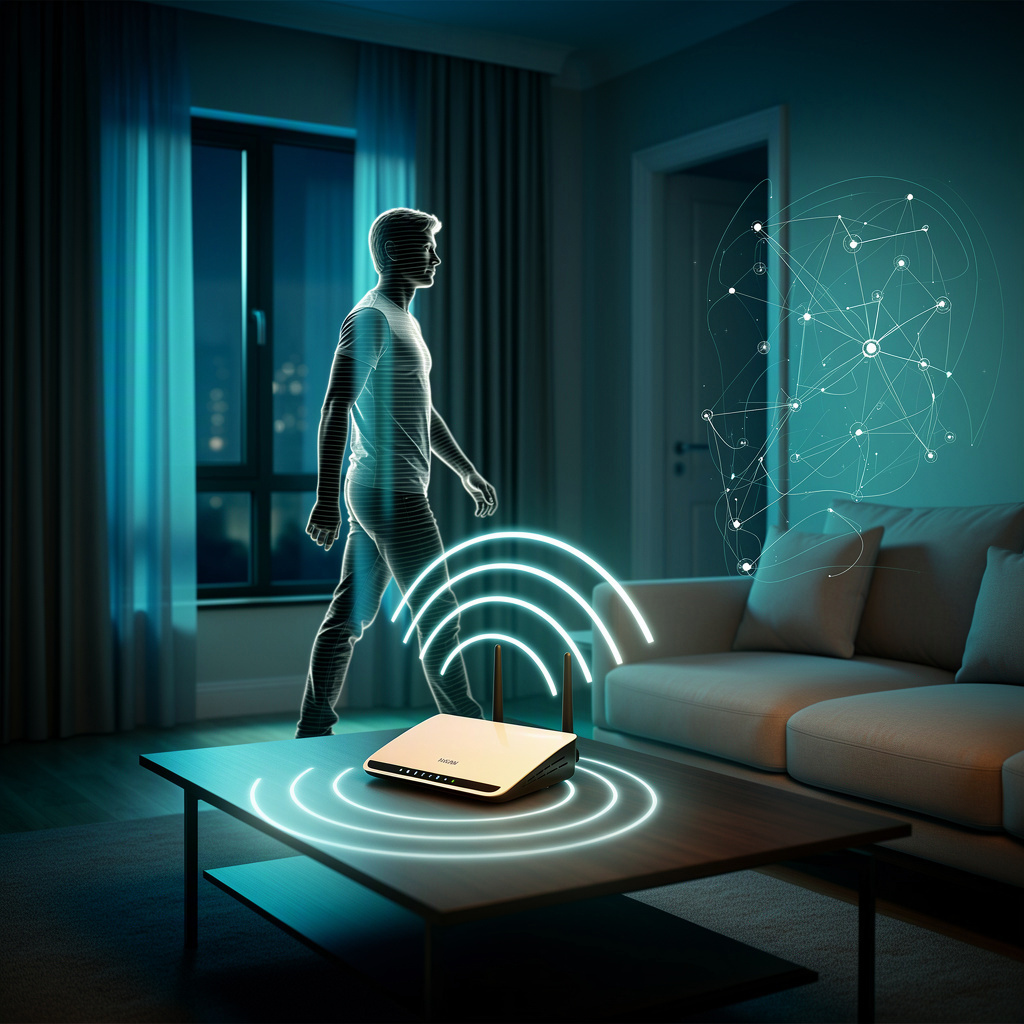
Wi-Fi is usually associated with connecting phones, laptops, and smart devices to the internet. The same radio waves can also reveal changes in an indoor environment, including human movement. This approach is known as Wi-Fi sensing. It may enable certain forms of room monitoring without cameras or wearable devices, but its capabilities and privacy implications should be understood realistically.
What Is Wi-Fi Sensing?
Wi-Fi sensing analyses changes in radio signals as they travel through a room and interact with walls, furniture, and people. When someone walks, sits down, or moves an arm, the signal paths and the characteristics measured by a receiver can change. A sensing system analyses those variations to estimate whether movement or a particular activity is occurring.
Unlike a camera, Wi-Fi sensing does not directly produce an image. However, that does not make it automatically anonymous. Long-term activity patterns can still reveal routines, occupancy, and behaviour.
How the Technology Works
1. Radio Signals Change
Wi-Fi signals are reflected and scattered by objects in a room. A moving person changes the propagation paths, which can affect the signal received by another device. These changes may be subtle and are not always visible through ordinary signal-strength indicators.
2. Devices Collect Channel Measurements
Some implementations analyse Channel State Information (CSI), which describes how the radio channel affects transmitted signals across subcarriers and paths. CSI can provide more detailed measurements than a basic received-signal-strength reading. Access to it depends on the hardware, firmware, drivers, and software implementation.
3. Algorithms Interpret the Patterns
The collected measurements are processed to distinguish movement-related patterns from ordinary variation, such as interference or environmental changes. A model may be trained to detect presence, broad activity, or a specific event. More specific claims require more representative training data and careful real-world validation.
Potential Use Cases
- Smart homes: trigger lighting or other automation when movement is detected, potentially reducing the need for separate sensors in every room.
- Space management: estimate whether a room is occupied to help control lighting or heating and cooling.
- Assistive research: investigate events such as falls, while recognising that experimental systems are not a substitute for validated safety devices.
- Energy management: understand room usage patterns where collection is transparent, proportionate, and appropriately authorised.
These are potential applications, not a promise that every consumer router already supports sensing. Device compatibility and software support vary considerably.
How It Compares with Other Sensors
A passive infrared (PIR) sensor detects changes in infrared radiation. Radar uses radio waves designed for sensing, while cameras capture images. Wi-Fi sensing attempts to reuse existing wireless infrastructure, which may reduce the need for additional hardware in some environments.
Reusing a Wi-Fi network does not guarantee a simple setup. A system may require access to low-level radio measurements, compatible devices, suitable placement, and calibration. Walls, furniture, nearby transmitters, and router movement can all affect results. For predictable detection, a dedicated sensor may be a better choice.
Accuracy and Reliability Limits
A setup that can detect general movement may not reliably distinguish similar activities. Results from one room may not transfer to another because radio propagation depends on the room layout. Test empty and occupied rooms, multiple people, open and closed doors, and interference from other wireless devices. Measure both false positives and missed detections.
The consequences of an error matter. A missed lighting trigger may be inconvenient; a missed safety event may be serious. Any safety-related application needs independent validation and an alternative mechanism.
Privacy Considerations
Wi-Fi sensing can reveal presence and routines even without images. People in the monitored space should know that sensing is active, what data is collected, who can access it, and how long it is retained. Prefer local processing where practical, minimise stored data, restrict access, and provide a way to disable monitoring. Do not activate sensing in private spaces without appropriate notice and consent.
Conclusion
Wi-Fi sensing shows that wireless networks can be used for more than carrying internet traffic. Analysing radio-signal changes may support smart-home automation and room monitoring, but performance depends on the environment, compatible hardware, and model quality. A responsible deployment tests real-world accuracy while protecting the privacy of everyone in the monitored space.
Komentar (0)
Belum ada komentar. Jadilah yang pertama berkomentar.